Skip to content
Case Study — Wesbridge Associates

How a London immigration practice went from a broken website to 250 enquiries in four months, without spending anything on advertising

A case study for IAA-regulated advisers — what Wesbridge Associates did, why it worked, and what it would take in your practice.

Wesbridge Associates, City of London IAA-regulated immigration advisers Website · content engine · practice system · client portal October 2025 – August 2026
1.07MGoogle impressions, 12 months
250enquiries in the last four months
£0spent on advertising

If you run an immigration practice, some of this will be familiar.

Enquiries arrive by email and get answered when someone has a moment. Client details are taken by phone and retyped into every document that needs them. Case progress lives in the head of whoever is handling the matter, so when a client rings to ask where things stand, someone has to go and look. Client care letters are assembled by hand from an old template. Your website was built once, by someone no longer available, and nobody dares touch it.

That was Wesbridge Associates in October 2025. They are IAA-regulated advisers in the City of London, and they came to Verkies because the header on their WordPress site had broken and nobody could fix it.

Ten months later their site is shown in Google over a million times a year, and in the last four months alone it has produced 250 enquiries, with nothing spent on advertising. Behind it, the practice runs on a single system: every lead, matter, application, document, letter, signature, appointment and payment in one place, with a client portal on the other side.

This is what changed, and what it would take to do the same.
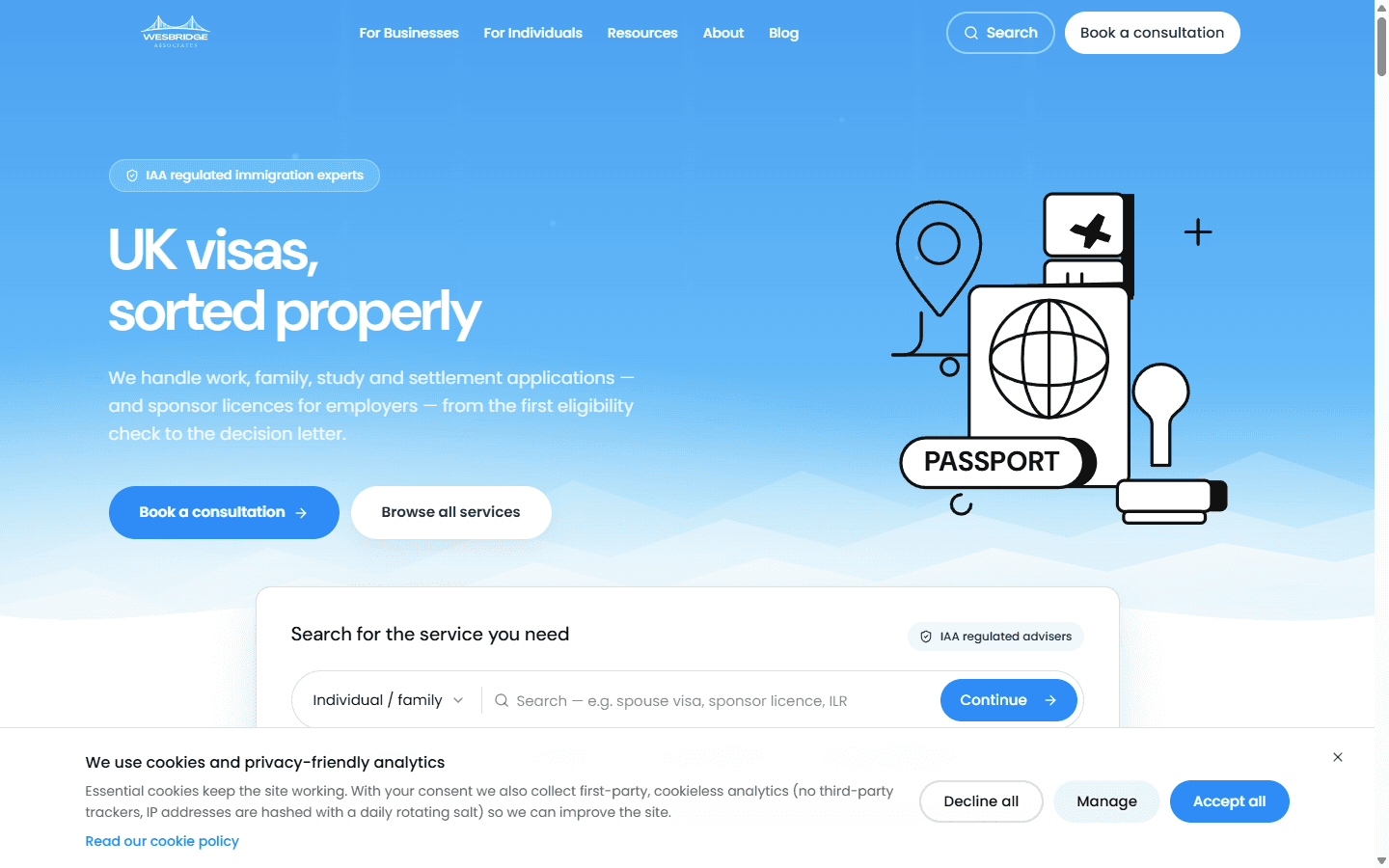
Visit live site

wesbridgeassociates.co.uk today — live, embedded above, not a mockup.

What Happened

The numbers, then the working

For the whole period before the rebuild, the impressions line sits flat against the bottom of the chart. Not low — flat. That is what a website nobody can update looks like in the data.

1.07MImpressions in Google, 12 months
9,320Clicks from search, 12 months
9thAverage position — first page of Google
100–150Daily search clicks now, from roughly zero at the start
250Enquiries in the last four months — roughly 60 a month, still climbing
£0Advertising spend across the whole period

Search figures: Google Search Console, wesbridgeassociates.co.uk, 12 months to August 2026.

Part One

Where immigration clients actually come from

Your clients search with unusual precision. Not “immigration lawyer” — they search “skilled worker visa salary threshold 2026”, “spouse visa English requirement”, “how long does settlement take”, “can I switch from student to skilled worker”. They are looking for a specific answer to a specific question about their own situation.

Most firms respond to this by bidding on the commercial terms, which are expensive and crowded, or by relying on referral and community networks, which work but do not scale.

Wesbridge went at the questions instead.

Twenty-nine visa route pages

Work, family, study, settlement, business, visitor — each built as a genuine reference: eligibility, current fees, processing times, documents required, common refusal reasons, FAQs. Every figure taken directly from GOV.UK under the Open Government Licence, with a visible last-updated date.

Seven tools people were already going to Google to use

A visa fees calculator. A salary calculator. A sponsor licence calculator. A continuous residence calculator. A licensed sponsor register lookup. An SOC code lookup. An EUSS eligibility checker.

A publishing pipeline, so adding pages stopped being a project

Drafting support, FAQ generation, scheduled publishing, automatic sitemaps, indexing requests, duplicate detection and quality scoring.

That is the whole mechanism. It is not a growth hack. It is answering the questions your clients are already asking, accurately, on pages that can actually be published — in a category where the searcher’s intent is unusually clear and their need is unusually urgent.

Why it compounds. Every page is a permanent asset. Ad spend stops working the day you stop paying; a good page on the settlement route earns attention for years. Ten months of consistent publishing produced 1.07 million impressions. It did not switch on — the chart climbs, stalls, then climbs again through the summer. Search rewards patience in a way paid channels do not.

Part Two

The system behind it

Traffic is only useful if the practice behind it can absorb it. Two hundred and fifty enquiries into an email inbox is not an improvement — it is a backlog and a compliance risk.

One spine: lead → matter → application

This is the decision everything rests on, and it is the difference between a system your advisers use and one they work around.

Lead Matter Application
DocumentsChecklistsMessagesAppointmentsTimeline eventsQuotationsPaymentsInvoices

Everything above sits under the matter. Nothing can be created as an orphan.

Every enquiry enters as a lead. When it becomes real work it becomes a matter, and the matter is the mandatory parent of everything that follows. Nothing can be created as an orphan — no document filed against an enquiry that later became a case, no email thread attached to an application nobody can find later.

For a regulated practice this is the point. When you need to show what advice was given, when, and on what basis, it is one screen — not a reconstruction from memory, an inbox and a shared drive.

What that looks like in the working day

Client care letters

An adviser workbench creates the matter, sends the client an intake form by link, and produces the engagement letter on the firm’s own letterhead. Boilerplate is locked so it cannot be broken; the sections requiring professional judgement are editable. Live preview, and a pre-send check that refuses to send a letter which has not rendered correctly. The client signs by link, the adviser countersigns, and the signed document is bound with an integrity hash and an audit certificate. Reminders go automatically at three and seven days.

The client portal

Nineteen screens, passwordless sign-in. A client sees their own matter: what stage it is at, what deadlines are approaching, what they still need to provide, which documents have been requested and received, their messages, appointments, fees and payments.

Applications

Document checklists per route, a review queue for data pulled off uploaded documents, a dashboard flagging incomplete or contradictory information, readiness scoring before submission, and a log afterwards.

Home Office forms, filled from data you already hold

A browser extension auto-fills portal forms from the applicant profile, with field matching and a preview before anything is submitted. The client typed that data once, themselves, at intake.

Regulated record-keeping, built in rather than bolted on

Complaints register as a first-class record. Per-matter email inbox, so correspondence lives with the case. Time entries against billing. Closure checklists. GDPR export and erasure. Role separation across admin, manager, adviser and client, with data access scoped at the database level.

Every screen removes a phone call that used to end with “let me check and come back to you.”

The design rule behind the client portal
TaskBeforeAfter
Client intakeDetails by phone, retyped into every documentClient completes a form by link; data populates matter, letter and Home Office forms
Engagement letterAssembled and formatted by handGenerated on letterhead from the matter, previewed, tracked
Getting it signedPrint, sign, scan, chaseTwo-party e-signature, automatic reminders
“Where is my case up to?”Adviser checks inbox and drive, calls backClient reads it in the portal
Chasing documentsEmail, then another emailRequest on the checklist, visible to both sides
Home Office formsRetyped from the fileAuto-filled from the profile, previewed
Producing a case historyAssembled from memory and emailOne matter screen, complete timeline
Run the arithmetic on your own practice.

We have deliberately not published a headline “hours saved” figure, because we have not measured one, and a number we invented would be worth nothing to you. The calculation you can do yourself is more useful anyway: take your matters per month, multiply by the minutes currently spent retyping client details, assembling letters, chasing documents and answering status calls, and annualise it. For most practices the intake retyping alone accounts for tens of hours a year before anything else is counted. Your own numbers will be more persuasive to your partners than ours.

Part Three

The compliance dividend

A significant part of this work was deletion.

29visa pages carried figures that were stale or had no source — wrong fees, wrong salary thresholds, wrong English language requirements
46data files of fabricated statistics were removed entirely
0success-rate claims remain — the old marketing claimed them; IAA-regulated advisers are not permitted to

A prospective client deciding whether they qualify, based on a salary threshold your site got wrong, is a real harm to them and a real exposure to you.

What is less obvious is that fixing it helped. The site now runs under explicit copy rules — no success-rate claims, GOV.UK figures reproduced under licence with dates attached — and traffic rose throughout. Accurate, sourced, dated pages are exactly what search engines are trying to reward, and exactly what an anxious client is looking for. In this sector, compliance and good marketing point the same direction.

What It Actually Takes

Honestly, so you can judge it against your own capacity

It is not a website project

The site is the front door; the value is the system behind it. Doing only the site gets you enquiries you cannot process properly. Doing only the system leaves you invisible.

Sequence matters

The case spine comes first — lead, matter, application, and the rule that nothing exists outside a matter. Retrofitting that later is genuinely painful; we had to do exactly that for Wesbridge, backfilling existing records to sit under matters after the fact. Get it right at the start.

Content is the long pole

Twenty-nine route pages built properly from primary sources is real work, and it is the part that cannot be rushed, because the whole benefit depends on the figures being right and staying right. Budget for maintaining them, not just writing them — fees and thresholds change.

Results arrive on search’s timetable, not yours

Wesbridge’s line was flat for weeks after launch. Meaningful traffic came months in, and the largest step up came around seven months. If you need enquiries next month, this is not that lever.

You will need someone to own accuracy

Every published figure needs a source and a review date. That is a standing responsibility inside the firm, not a one-off task.

Where to start, this week

Useful whether or not you ever speak to us.

1
Open Google Search Console for your own domain

If you have never set it up, do that first. Look at total impressions over twelve months and your average position. That is your baseline, free, in about ten minutes.

2
Write down the last ten enquiries and where each came from

Referral, search, ads, walk-in. Most firms are surprised, in one direction or the other.

3
Time one engagement letter, end to end

From first contact to signed and filed. That single number tells you more about your operational headroom than any software demo.

4
Pick the one route you most want more of, and check your own page on it

Read it against GOV.UK today. Check the fee, the threshold, the English requirement. If anything is out of date, you have found both a compliance issue and your starting point.

If You Want to Talk

The diagnosis is free, and we will tell you if the answer is that you do not need us

We built this for Wesbridge over ten months, and we would approach another practice the same way: the case spine first, the regulated workflows next, the content engine last, with the site rebuilt around them rather than in front of them.

Send us what is currently broken — the header, the inbox, the retyping — and we will tell you whether it is a website problem or a foundation problem.

Or email hello@verkies.co with the thing that broke.